
ES · EN
Contact us
Remote driving and remote assistance over 5G
A remote station from which a person drives drive-by-wire vehicles over public or private 5G, with on-board LiDAR emergency braking and an automatic stop if the link degrades.
The teleoperation station: the operator drives from the room.
Our own building block that brings together low-latency video, perception for emergency braking and link monitoring.
In some situations an autonomous vehicle needs a person to decide how to continue. With Seevia Teleoperation, an operator takes control from the control station and hands it back once the situation is solved.
The operator solves the situation from the control station, and nobody has to travel to the vehicle.
If the link quality drops, the vehicle stops safely on its own.
An integrated data logger records each session for later review.
Illustrative diagram
< 100 ms
target teleoperation latency
01
Cameras all round, front LiDAR and a drive-by-wire link.
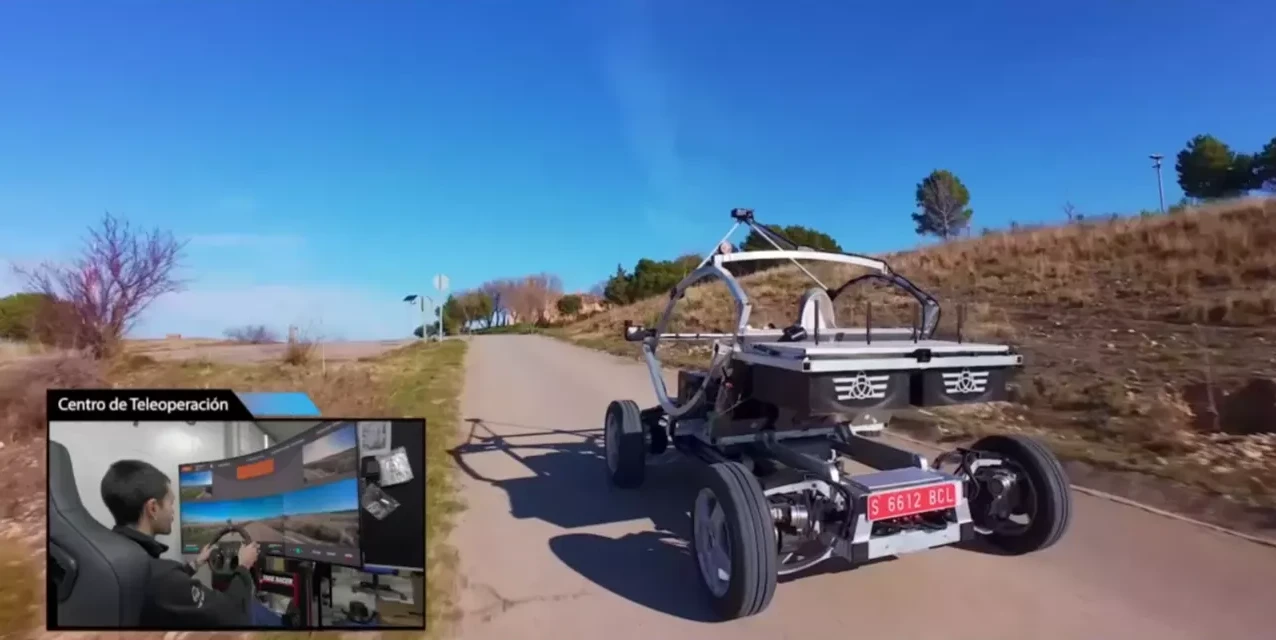
Remote station and vehicle in the same test.
02
Immersive screen, force-feedback wheel and pedals.
03
The operator sees the vehicle's whole surroundings.
The operator's interface, with several vehicle cameras.
04
If the link degrades, the vehicle stops; every session is logged.
In each project we choose and mount the equipment the case needs. These are the elements we work with.
Cameras around the vehicle, LiDAR, an on-board computer, 5G connectivity and an interface to the vehicle's drive-by-wire control.
Screen, steering wheel and pedals, with an interface adapted to each operation.
Public or private 5G, or wifi on sites, depending on each deployment.
A light electric vehicle manufacturer
We integrated the kit, the remote station and emergency braking with on-board LiDAR to drive remotely and safely even if the network fails.
See the project →
GENIUS · R&D project
At the Port of Barcelona, each new car goes from the reception row to its bay in the yard under remote supervision. We take part in the teleoperation.
See the project →

If link delay stays above the safety threshold, the vehicle stops automatically. The operator can also stop it at any time with the emergency stop.
It depends on each deployment: we measure the real network quality before starting.
Each deployment follows the applicable regulations; the usual approach is to start on closed sites.
Tell us your case and we will look at it with your data.
Next
Seevia ATLAS