
ES · EN
Contact us
Development and validation of driver assistance
Adaptive cruise control, emergency braking and lane keeping developed for each vehicle under European regulations, and tested in simulation before the track and the road.
Urban driving assistance, in simulation.
Our own building block that brings together perception, control and simulation with digital twins. On it we develop the functions your vehicle needs.
Validating driver assistance on a track is slow and misses dangerous cases. With twins of vehicle and environment, each function is tested first in simulation.
Each function is tested first in simulation, with twins of the vehicle and its surroundings, and the track confirms what has been tested.
Rare or dangerous situations, such as night or tunnels, are rehearsed in simulation.
Each function is developed under European regulations, with ASIL-B safety in the control units.
01
Keeps the distance to the vehicle ahead.
Adaptive cruise control, in simulation.
02
Brakes for an obstacle if the driver does not react.
Automatic emergency braking, in simulation.
03
Low-light scenarios examined in simulation.
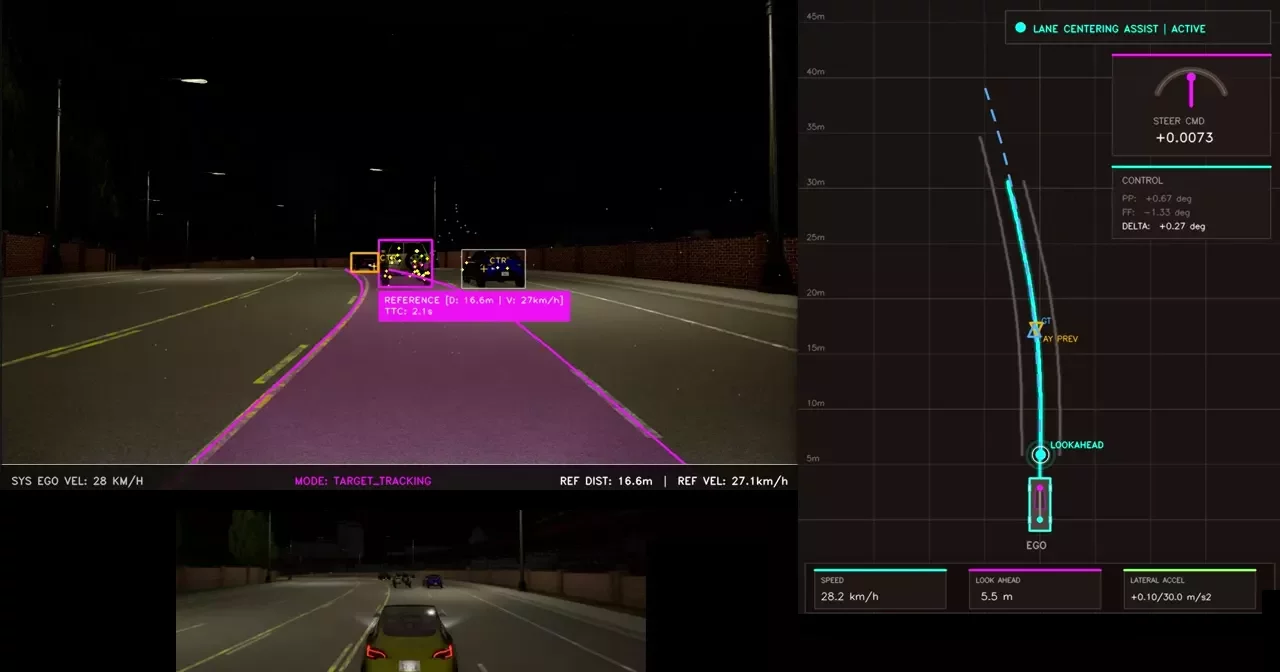
Assistance at night and in a tunnel, in simulation.
In each project we choose and mount the equipment the case needs. These are the elements we work with.
Cameras, LiDAR and radar chosen and calibrated for each function.
ASIL-B safety and supervision functions on the vehicle's control units.
A twin of the vehicle and its surroundings to test each function before the track.
A major engineering group
We advised on and co-developed a complete simulation stack to digitise advanced driver assistance systems (ADAS) and put their failures in the context of each road and environment.
See the project →
A major European car manufacturer (OEM) · Obelix project
We added a safety ECU that supervises the driving system.
See the project →
A tier-1 automotive supplier
Through simulation, we designed a complete sensor suite for an intelligent recording vehicle, minimising blind spots.
See the project →
Those each project requires, within the framework of European safety regulations.
In simulation, on a test track and on the road, with scenarios defined in advance.
Cameras, LiDAR and radar, chosen and calibrated for each function.
Tell us your case and we will look at it with your data.
Next
Seevia Teleoperation