
ES · EN
Contact us
Human hand, onboard safety
An operator sees six cameras and LiDAR over 5G and drives with wheel and pedals; drive-by-wire executes. Emergency braking runs on board, so safety does not depend on the network.
The operator's interface, with several vehicle cameras.
The vehicle streams video over 5G; the operator decides and sends commands; drive-by-wire executes them. The decision is human. We add safety layers: module monitoring and autonomous braking on board.
Mobile networks change from one moment to the next. So we reduce video and command delay, and the vehicle knows how to stop by itself if the connection drops.
Illustrative diagram
01
Cameras and LiDAR give the operator the full view, on a drive-by-wire vehicle.
02
5G router: commercial on public roads, Wi-Fi on private sites.
03
Cabin with immersive screen, wheel, pedals and web interface.
04
The vehicle brakes on its own in front of an obstacle, even if the operator does not react.
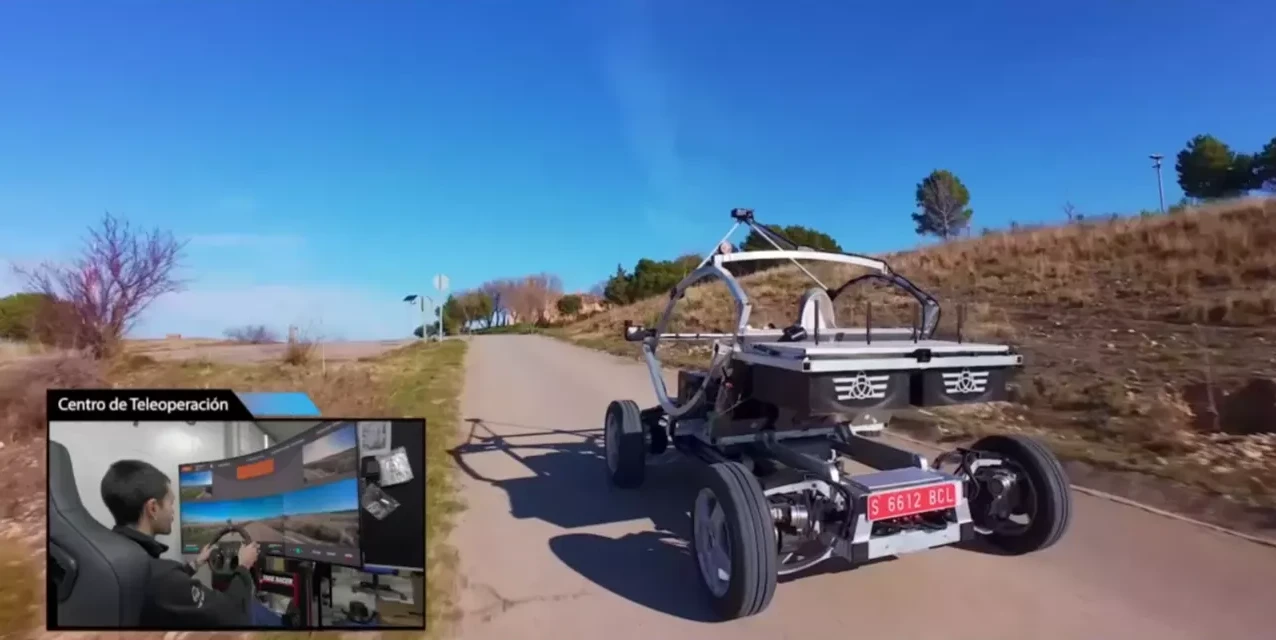
Remote station and vehicle in the same test.
The vehicle brings itself safely to a stop.
On closed sites and in tasks where having a person on board is not worthwhile.
Yes. One person supervises several and attends to the one that needs it.
Tell us your case and we will look at it with your data.
Next
Twins and simulation