
ES · EN
Contact us
Since 2024 a system on board our client's vehicles locates and classifies, along the usual route, waste next to containers and alerts their platform.
Technologies
Computer vision
Detection and classification
On-board anonymisation
Georeferencing
On-board processing
Client platform
Before the commercial launch, a pilot on the route refined the requirements and the sensor mounting. The commercial launch came in the third quarter of 2024.
Detect automatically, along the route, the waste left next to containers, with anonymisation done on the vehicle itself.
Today 13 service vehicles run Seevia Waste in Madrid, Valladolid, Zaragoza and L'Hospitalet de Llobregat. The next planned deployments are Bilbao, Vigo, Granada and the Canary Islands.
Illustrative diagram
01
The cameras and the computer are mounted on the service vehicle and analyse the images along the route. Only the alert reaches the platform.
02
Each alert arrives with place, time and an encrypted image when there is an incident to deal with, integrated with our client's platforms.
03
We store no images, blur pedestrians and vehicles and crop the area of interest.
04
Besides detecting the waste, the system tells what type it is, so the right service can be sent.
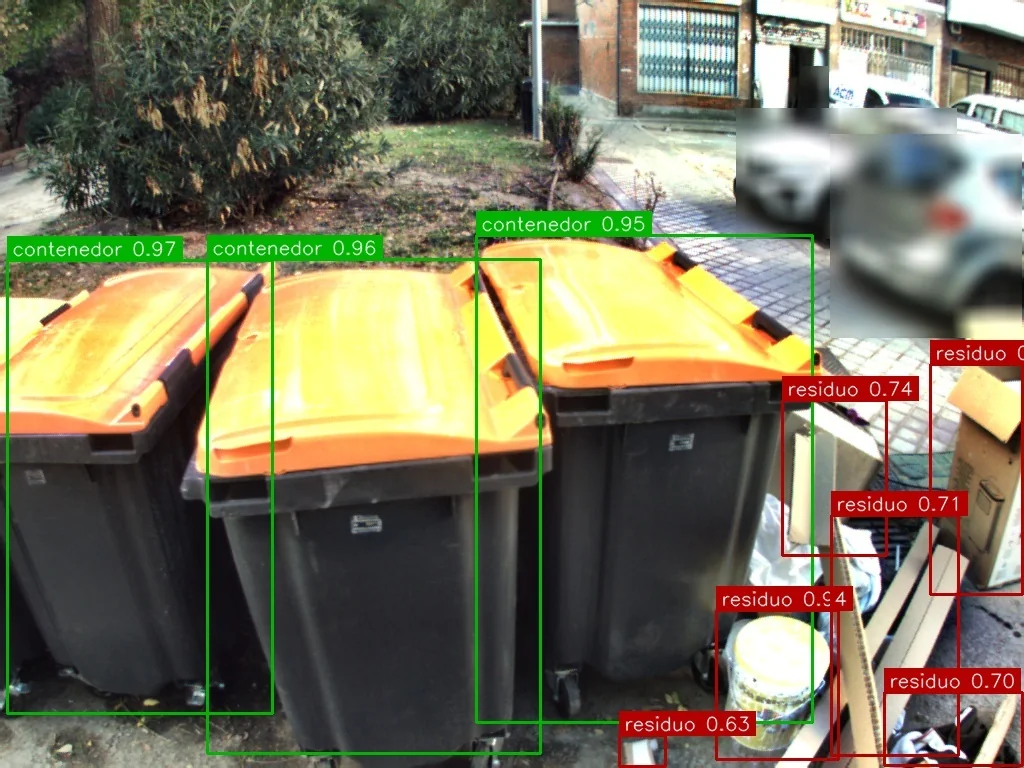
Waste next to the containers, detected on board.
Both side cameras on the route: people and plates are already blurred.
Running around the clock since late 2024. In 2025 we improved precision in the cases that were most often confused. In 2026 detection improves with more data and the system classifies the type of waste.
Measured on morning, afternoon and night sequences. With poor visibility, 88.88%.
Manual review of alerts against the image · October 2024
It gets more right and detects 2.5 times more incidents over an equivalent period.
Night images reviewed by hand · March 2025
Measured on the most frequent waste classes.
Our own daytime control set · March 2026
Disproportionate alerts fall to 9.6%, the project's lowest.
Daytime and night images reviewed by the team · April 2026
Before the third quarter of 2024
Detection pilot for containers and waste, integrated with our client's platform.
Third quarter of 2024
Commercial launch, with industrialised on-board equipment.
Late 2024 and early 2025
Around-the-clock operation, at night too.
Second and third quarter of 2025
More precise detection and connection to Mawis.
November 2025
Classification of the type of waste begins.
2026
Improved detection with more data and industrial-grade equipment.
Yes. Each case is studied and adapted to its environment and the way it works.
With a study of your case and a scoped pilot before extending.
Write to us and let's talk.
Next
A major engineering group