
ES · EN
Contact us
Deciding with safety layers
Autonomous vehicles must know what to do if a sensor degrades or a module fails. We plan the route on the map, execute it with commands to the vehicle, supervise every module, and a safety ECU brakes in an emergency, even if the network fails.
The vehicle follows the planned route through the city, in simulation.
Navigating is choosing a route and trajectory without collisions, from the map and what is perceived. Controlling is turning it into commands for steering, throttle and brake. A supervisor watches each module; if one fails, it orders a planned reaction: slow down or stop.
An autonomous vehicle must fail safely. Many old stacks do not. They must be modernised without losing what already worked.
Illustrative diagram
01
The route is planned with the map and the position.
02
The trajectory becomes commands on the vehicle bus.
03
We monitor each module's status and define how to react to a failure.
04
A safety ECU brakes in an emergency; automatic braking adds redundancy.
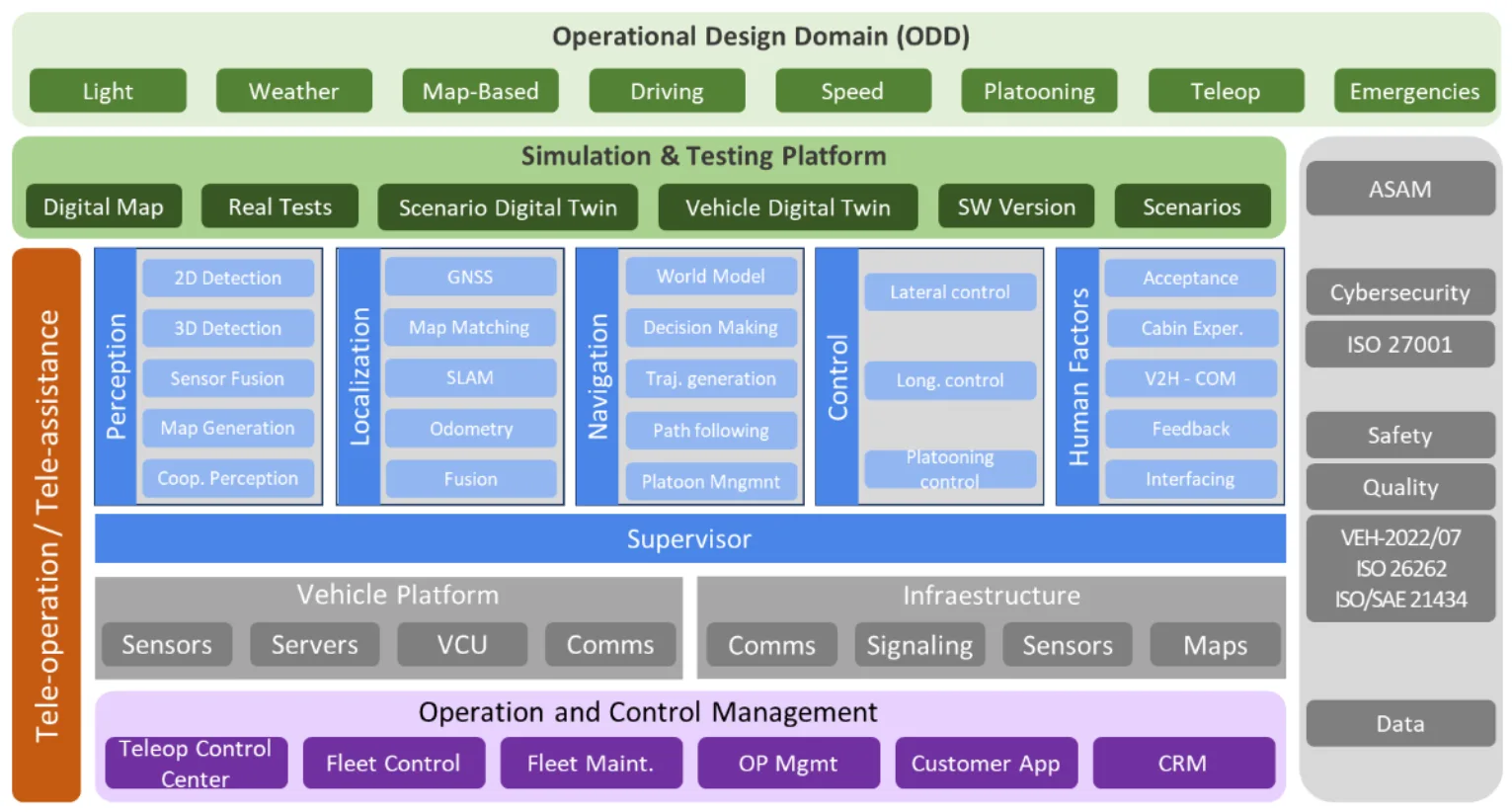
The driving architecture, layer by layer.
The vehicle stops safely and, if needed, a person helps it remotely.
Yes, depending on the configuration of each vehicle and operation.
Yes. We work on open architectures to integrate with what you already have.
Tell us your case and we will look at it with your data.
Next
5G teleoperation